
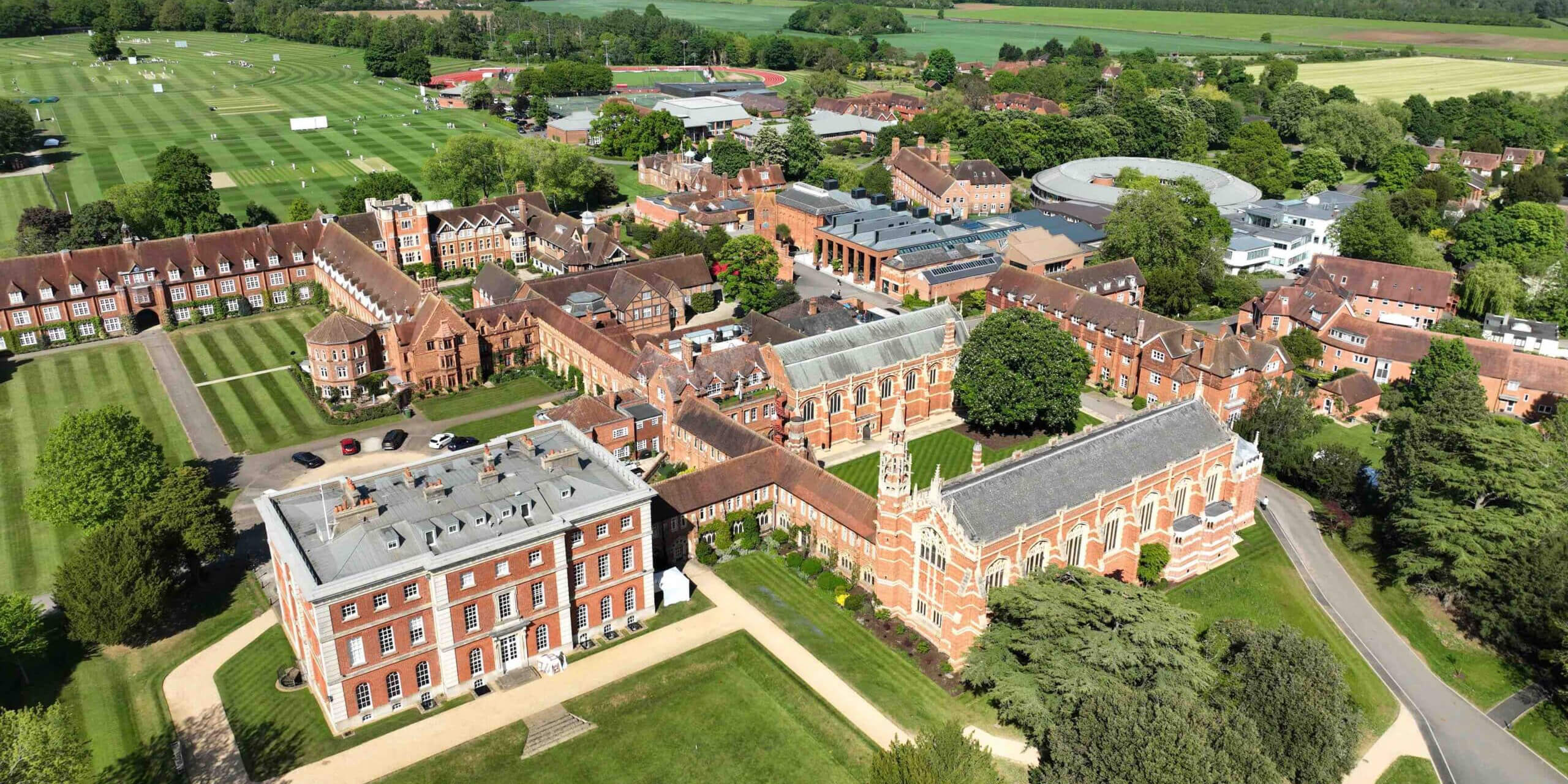
Beyond the School Gates: How Radley’s commercial enterprise is building community
An interview with Les Newell, Head of Commercial Enterprises and Sports Centre, Radley College
At Radley College, commercial enterprise is about more than generating income. For Les Newell, it is also about opening up the school’s facilities, strengthening local relationships, and making sure the College is used well beyond term time. In this interview, Les reflects on how his role has developed, the challenges of operating a near year-round enterprise, and why community connection remains at the heart of the work.
Q: Can you start by giving us an overview of your role and how it fits into the wider organisation?
I am Head of Commercial Enterprises and Sports Centre – or Head of Sports Centre and Commercial Enterprises; you could put it either way. I have been at Radley for 18 years, starting as Head of the Sports Centre in 2007. Back then there was no gym, no gym membership scheme for the local community, and while plenty of people used the swimming pool through clubs, that was about it.
Over the years, the facilities have changed a lot. The real tennis court was added in 2008, and we have steadily grown both our membership and our links with the community. We now have more than 900 external members, which is a great number for a small village, and we also attract people from Abingdon and the surrounding area.
In 2021 I was asked to take on the wider commercial role at Radley, so it was no longer just about the Sports Centre. We now oversee theatre productions hosted here for external dance companies and drama groups, hire out the Mansion rooms, make boarding houses available during Easter and summer, and look at everything we can do to generate additional revenue for the College.
That income is increasingly important, but it is not only about money. As with the Sports Centre, it is also about developing community links. Rather than being seen simply as an independent boys’ school in the village, we are very much part of the village. We work closely with the partnerships team too, and while it is not always seamless, the main focus is bringing people from outside the College in, particularly outside term time.
Q: What challenges have you come across as the role has developed?
I think the biggest challenge is probably people’s fear of the unknown. When we suggest something new, people naturally ask: how is that going to work, what will it affect, and will it add pressure to something we already do?
You learn how to navigate that and think through potential problems in advance. Sometimes there are legitimate issues, so we try not to suggest anything that would be too disruptive. For example, we have 11 boarding houses and around 750 boarders. The day after the boys leave in July, when staff are about to enter their downtime, we might bring another 400 or 500 people onto site. That inevitably creates extra work and pressure.
The challenge is helping people see the benefit while being honest about the resources required. Partnerships face similar pressures during term time, so it is about being aware of the impact on people, facilities and the wider College.
Q: What do you find most exciting or inspiring about the work?
It is easy to get bogged down in day-to-day issues, but I try to look at the bigger picture. For me, the most pleasing part is the connection with the local community, especially through the sports facilities. I live in the village, so I might see people walking up to a fitness class, or someone will tell me they have just been swimming, or that their child loved one of our kids’ camps. That direct feedback matters. Yes, the activities generate income, but you can see that they are also making a difference. Radley is a small village, and when I walk home in the evening and see people heading to the Sports Centre, it feels like a real benefit to the community.
We are lucky to have facilities that are comparable to a good town sports centre, and we try to make the most of that. So many people say they learned to swim here or came here as a child, and that stays with them. Our swim school is now thriving, with around 400 children coming through each week.
Q: What can people access through the Sports Centre?
There is so much you can do at Radley Sports Centre. We have more than 900 gym members and around 400 children a week in the swim school, so nearly 1,500 people are coming through the building through those two activities alone.
Members can use two gyms: a fitness suite with cardiovascular equipment and resistance machines, where we also run small group circuit classes, and a separate free weights area. They also have access to swimming, with up to three swim times a day, adding up to around four or five hours daily.
Alongside that, we run the swim school, kids’ pool parties, squash courts, sports halls, badminton, five-a-side football and cricket nets. Outdoors, we oversee AstroTurf pitches used for hockey and football by local clubs including Kennington Youth, Radley Youth, Abingdon Youth and Abingdon Hockey Club. The real tennis court is also available and is a distinctive part of what we offer.
Q: And outside sport, what other commercial activities are developing?
One recent success has been a farm camp based at our Countryside Centre. Not many places have the luxury of a smallholding with sheep, pigs, dogs, goats and other facilities. We ran a course there in May half-term for 12 children, and it was probably the best single product I have seen in terms of how quickly it sold. The August camp has already sold out too.
There is clearly demand, and we have the facilities, but scaling it up is the challenge. It comes back to people and staffing: how do we get enough people to run the courses while also giving them time off? It has been very successful, so now we need to work out how to harness that in a sustainable way.
Q: When you took on the wider commercial role, what strategies did you put in place?
I applied the same ethos that had worked at the Sports Centre. It is not always about the product itself; it is about the processes behind it. How do we set something up, run it well and make it sustainable?
There were already commercial elements at Radley, including some residential groups, but we attracted more, reviewed the pricing and built stronger relationships with partners. I felt that some facilities were being undersold, either because they were not being sold at all or because the price point was too low.
The focus has been on long-term partnerships rather than one-off bookings. You could make a lot of money quickly by selling boarding houses for two weeks as a one-off, but that is not sustainable. We want to work with groups who are likely to return year after year. Once those bigger blocks are in place, we can add other opportunities around them, including theatre hire, better website and social media visibility, and easier booking processes.
One lesson I learned early on is not to do too much too soon or try to please everyone. When you are starting out, the temptation is to offer everything and charge very little just to get people through the door. That can work at first, but it can create problems later. If what you are offering is worthwhile, people will pay for it, so it is important to have a structure and stick to it.
Q: How do schools need to think more commercially?
More schools are realising they need to bring in additional revenue, and that is creating both opportunity and competition. Fifteen years ago, only a few schools with facilities were actively letting them out, whether through summer residential lets or sports facilities. Now more schools are entering that commercial space, which makes it harder for everyone.
For residential groups, we are competing with any school with boarding facilities within around 90 minutes of Heathrow. That is a large market. What we deliver must be better, cheaper, or ideally both. It is a fine line, because we may want to charge more, but that does not always mean the market allows it.
Commercial activity in schools has become a more recognised part of the sector. That visibility is positive, but it also means standards must be very high. If more schools are offering similar facilities, you cannot assume people will come to you automatically. You must be good at what you do.
Q: How is the international market changing?
It is a volatile market. The groups we work with are all trying to sell their programmes and places, often through agents and their own marketing. It is becoming more difficult for them, so it is important that we work closely with our providers and showcase what we can offer students when they are here.
If a family in Singapore is comparing two or three options in the UK, they need a reason to choose us. That means showing the value of the Radley experience, whether it is a sports camp, a lecture-based programme or something else.
Two years ago, numbers were strong across the board, but now some schools are seeing reductions. Some of the newer schools may struggle because the market can change quickly. In two or three years it could take off again, but for now we must manage the risk carefully.
Around 70% of our external income comes in during six weeks in the summer through residential camps. That is significant, so we are trying to grow other areas – theatre, kids’ camps, the Sports Centre and other activities – not to reduce residential income, but to reduce the percentage it represents. If the international market disappeared, it would have a major impact.
Q: What might surprise people about your role?
People might be surprised by how hands-on it is. As Head of Commercial Enterprises, I still need to physically do the job at times: putting up signs, moving bins around boarding houses, dealing with whatever needs doing. In my view, unless you have a very large team, it will not work if you just sit in an office and try to direct everything from there. I personally don’t mind that. In the summer it is tiring, but we quite enjoy getting stuck in. I think people might assume the role is about moving paper around or waiting for the money to come in, but it is not like that at all.
The other surprising thing is how much income is needed. We are fortunate to generate good external income across our facilities, including the golf course, but people do not always realise how much it costs to run a place like Radley College. With stately homes, people understand that visitors help pay for maintenance and major projects. With independent schools, there can be an assumption that there is simply a lot of money available.
In reality, there is a huge amount to spend on day-to-day operations, feeding pupils, maintaining facilities and investing in the estate. If I want new squash court floors, that need sits alongside everything else the College requires, from classrooms to maintenance projects. That is why external income matters: it helps us keep improving and supports the wider life of the College.
Les Newell joined Radley College in 2007 as Head of the Sports Centre, bringing extensive experience from managing local authority leisure facilities. At that time, the College’s sports provision for the wider community was relatively limited, with access largely restricted to evening use of the sports hall and swimming pool, and no dedicated gym facilities on site.
Over the past two decades, he has overseen the development of a thriving community sports programme, supported by significant investment in high-quality facilities. Community engagement has remained central to the Radley vision, and today more than 900 members enjoy access to two fully equipped gyms and an extensive programme of fitness classes.
In September 2021, he was appointed Head of Commercial Enterprises, extending this community-focused and commercially driven approach across the College’s wider estate. The role encompasses the management and promotion of a broad range of facilities, including boarding houses, the Theatre, Chapel and function spaces. Since then, the College has expanded its programme of events and commercial activities, creating valuable experiences for visitors while generating an important source of income that supports the wider work of the College.
Outside of work, he is a passionate runner and regularly competes in Masters athletics events. In October 2025, he represented his age group at the European Masters Athletics Championships, where he achieved fifth place in the 1500 metres.